

10 Website Design Trends 2026 Businesses Need.
Website design trends 2026 focus on speed, clarity and mobile-first UX. See what matters most for businesses that want more enquiries.
A good website in 2026 will feel lighter, clearer and faster to use. That is the real shift behind website design trends 2026. Not more visual noise, not novelty for its own sake - just better decisions that help people find what they need, trust what they see and take action on any device.
For small to mid-sized businesses, that matters more than ever. If someone lands on your site from a Google search on their mobile, the design has a job to do quickly. It needs to explain who you are, what you offer and what to do next, without making people work for it.
Website design trends 2026 are moving toward clarity
The strongest design trend for 2026 is restraint. Layouts are becoming more disciplined, with clearer spacing, stronger hierarchy and fewer competing elements on the page. That does not mean websites are becoming plain. It means they are becoming easier to use.
For a trade business, law firm, clinic or local service provider, this is good news. A homepage does not need five sliders, three menus and a wall of badges. It needs a clear headline, a believable value proposition, supporting proof and a direct path to enquire, book or call.
This shift also reflects how people browse now. Most users scan first, then commit. Design that respects that behaviour tends to convert better than design that tries to impress at every step.
Simpler interfaces with stronger intent
Minimalism is not new, but in 2026 it is more functional than aesthetic. The better sites are reducing decoration that slows the page or distracts from key actions. Buttons are more obvious. Navigation is shorter. Sections have a purpose.
There is a trade-off here. If a brand strips things back too far, the site can feel generic. The balance is keeping the interface simple while still showing personality through typography, imagery, tone and small visual details.
Mobile-first is no longer a design option
Mobile-first design has been standard advice for years. In 2026, it is just the baseline. If a site feels awkward on mobile, users notice immediately, and search visibility can suffer as well.
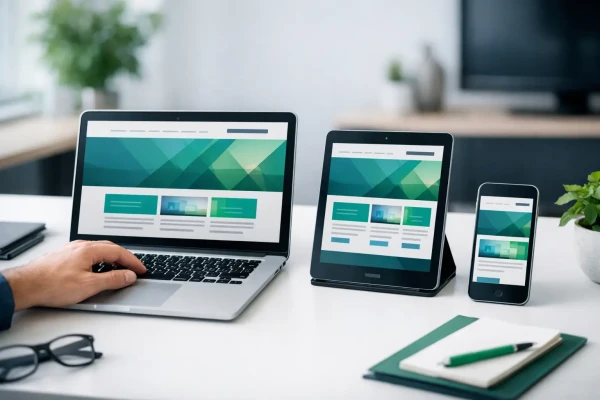
What is changing is the level of care expected. It is not enough that a page technically fits on a small screen. It needs to be comfortable to use one-handed, quick to scan and easy to act on. That means thumb-friendly buttons, tighter forms, sticky call-to-action patterns where appropriate, and content blocks that stack cleanly.
For local businesses, especially service-based businesses, this often makes a direct difference to leads. A person looking for a roofer, accountant or physio on their mobile usually wants a fast answer. Design should support that behaviour, not interrupt it.
Navigation is getting shorter
One clear pattern in website design trends 2026 is compressed navigation. Businesses are reducing bloated menus and grouping content more logically. Users do not want to decode your internal structure. They want a direct path to pricing, services, examples, FAQs and contact details.
That often means fewer top-level menu items, clearer page naming and better use of internal page structure. In practice, this is less about visual design and more about information design, but the result is the same - faster progress for the user.
Performance is part of the design brief
Fast sites look better because they feel better. That is one of the most practical changes happening in 2026. Performance is no longer treated as a technical task that happens after design. It is part of design from the start.
Heavy animations, oversized videos and image-led hero sections are being used more carefully. Designers and developers are making earlier decisions about what earns its place on the page. A polished effect is fine if it supports the message and does not slow the experience down. If it adds friction, it is usually not worth it.
This is especially relevant for businesses that rely on paid traffic, local search or repeat visits. A page that loads quickly and behaves consistently across mobile, tablet and desktop has a better chance of keeping visitors engaged.
Motion is staying, but it is becoming more disciplined
Subtle animation still has a place. Hover states, gentle transitions and scroll-based movement can help guide attention and make interfaces feel current. In 2026, the better use of motion is restrained and purposeful.
There is a clear line here. Good motion supports orientation and feedback. Bad motion delays interaction or makes the site feel overproduced. If users have to wait for content to appear or buttons to settle into place, the design is getting in the way.
AI-assisted content needs stronger visual trust signals
As more businesses publish AI-assisted copy and imagery, trust has become a design issue as much as a content issue. People are getting better at spotting vague language, stock visuals and pages that feel assembled rather than considered.
That is why more websites are leaning into proof-based design. Expect to see stronger use of real project photos, team imagery, testimonials with context, specific service details and clearer process sections. These elements are not new, but in 2026 they matter more because they help separate a real business from a templated web presence.
For professional services and local operators, this can be simple. Show the team. Show the work. Explain how the process runs. Make contact options visible. Design should reinforce credibility, not just style.
Typography is doing more of the heavy lifting
One noticeable change in modern sites is how much clearer typography has become. Brands are using type to create structure, pace and personality without relying on extra graphics.
Larger headings, more generous spacing and better contrast are all part of this. It helps accessibility, improves scan-ability and gives content room to breathe. In practical terms, this means a service page can feel modern without needing complex design treatments.
The caution is readability. Oversized type can look sharp in a mock-up but create awkward line breaks or scrolling issues on mobile. Good typography still needs testing across real screen sizes and real content lengths.
Accessibility is becoming standard practice
Accessibility is one of the healthiest design trends heading into 2026 because it improves usability for everyone. Better contrast, clearer focus states, sensible heading structure, descriptive buttons and form labels all make a site easier to use.
This does not have to make a website look clinical. In most cases, accessible design looks cleaner and more professional. It also reduces friction for users who are trying to complete basic tasks quickly, which is exactly what most business websites need.
For organisations that serve broad audiences, this is not just a technical checklist. It is part of good service. If someone can navigate your site, read your content and contact you without effort, the design is doing its job.
Content blocks are replacing long, generic pages
Another practical shift in website design trends 2026 is the move away from long pages full of broad statements. Instead, businesses are using modular content blocks with clearer purpose. One section answers one question. One block supports one decision.
This structure works well because it gives visitors quick wins. They can skim service inclusions, process steps, pricing signals, reviews and contact prompts without digging through filler. It also makes websites easier to maintain over time.
For platforms such as WordPress and OctoberCMS, modular content design has another advantage. It supports cleaner updates, more consistent layouts and less risk of pages becoming messy after edits.
Brand personality is becoming quieter but sharper
The loud version of branding is fading. In its place, more businesses are using a calmer visual style with stronger discipline. That might mean a limited colour palette, a consistent image style, one or two standout type choices, and tighter copy.
That approach suits service businesses well. You do not need to look flashy to look current. You need to look competent, clear and easy to deal with. For many businesses across places such as Tauranga, Rotorua and Mount Maunganui, that is the difference between a site that feels credible and one that feels like it is trying too hard.
What businesses should actually do next
If you are reviewing your site this year, do not chase every trend. Start with the basics that produce usable gains. Check mobile navigation, page speed, headline clarity, contact paths and form friction. Review whether your pages answer real customer questions quickly. Then look at design refinements that support those goals.
A full redesign is not always necessary. Sometimes the right move is tightening structure, improving typography, simplifying templates and upgrading performance. Other times, an older site needs a complete rebuild because the layout, codebase and content model are all fighting against modern expectations.
The useful test is simple. If your website helps people understand, trust and contact your business with minimal effort, you are on the right track. If it feels busy, slow or vague, the next round of improvements is already clear.
The best trend to follow in 2026 is not a visual trick. It is designing with intent, so every part of the site helps someone move forward.
Need a hand with something? Talk to us about web design and development.
Ngā Pōhi e Hāngai ana
 Pōhitia ki hea Mahuru, 2026
 Pōhitia ki hea Mahuru, 2026
 Pōhitia ki hea Hōngoingoi, 2026
Whakapā mai me ka hiahia kia whakaterehia ā-matihikotia tāu pakihi!
Pae tukutuku, SEO & SEM, hoahoa atahiko, taupānga kawekawe, pūtaurima pae tukutuku – kōrero mai..